Safeguarding Policy
1. Safeguarding is Everyone’s Responsibility: The purpose of this safeguarding plan is to ensure the safety, well-being, protection and human rights of all participants - players, staff, volunteers, spectators, and minors—involved in the Soccer 7’s Series Singapore, in accordance with Singapore law and international safeguarding standards.
“Safe Sport Unified Code”: Defines, describes and explains the forms of abuse and harassment which may take place in the sporting environment. View at: www.safesport.sg
“Safe Sport Programme”: A framework for applying, implementing and enforcing the Safe Sport Unified Code. It includes policymaking, training and a case management service.
Legislation and guidance: This policy is based on consideration of the safeguarding responsibilities of all involved in the tournament and with guidance from Safe Sport commission SG documentation and the Safe Sport Unified Code.
- A Person commits a breach of this Policy when they, either alone or in conjunction with another, engages in any conduct which constitutes Misconduct under Article 4 of the Unified Code:
- a. Offences Under Domestic Law
- b. Sexual Misconduct (e.g. Sexual Harassment, Sexual Contact without Consent, Sexual Communications)
- c. Psychological & Physical Misconduct (e.g. Bullying, Harassment, Hazing)
- d. Other Inappropriate Contact (e.g. Grooming, Intimate Relationships, Other Inappropriate Conduct)
- e. Misconduct related to Process (e.g. False Reporting, Abuse of Process, Retaliation)
- Safe Sport Unified Code (Full Document)
2. Legal and Policy Context (Singapore)
This plan is informed by:
- Children and Young Persons Act (CYPA) – which provides protection for individuals under 18 years.
- Women’s Charter – protection from family violence and exploitation.
- Penal Code and Protection from Harassment Act (POHA) – addressing abuse, harassment, and exploitation.
- Sport Singapore Safe Sport Programme Framework – aligning with national sporting standards.
- IOC consensus statement: interpersonal violence and safeguarding in sport. 2024.
- Various international SafeSport frameworks including the National Child Protection in Sport Unit UK and Athlete365.
3. Definitions
- Child or Minor: Any individual under the age of 18.
- Vulnerable Adult: Any adult who may be at risk due to mental or physical disability or dependency.
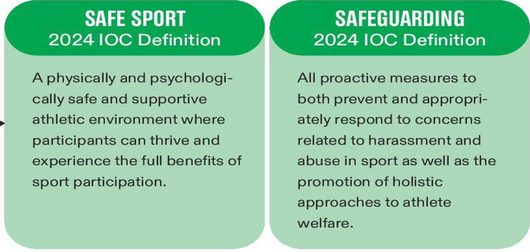
- Safeguarding: Measures to protect individuals from harm, abuse, neglect, and exploitation.
4. Scope of the Plan
- All players (men’s and women’s teams)
- Coaches, referees, team managers
- Volunteers and event staff (including medical).
5. Roles and Responsibilities
- a. Safeguarding Officer (SO)
- • Designated for the tournament; trained in safeguarding by the SafeSport commission SG.
- • Oversees safeguarding implementation and handles all reports of misconduct.
- b. Team Officials and Players
- • Officials/Team managers/Coaches must attend the safeguarding briefing.
- • Players must be sent access to the safeguarding and Code of Conduct prior to the tournament.
- • Officials/Team managers/Coaches are responsible for team conduct (see code of conduct) and safety.
- • It is the responsibility of the individual teams to ensure Officials/Team managers/Coaches traveling with the teams have the relevant backgrounds checks.
- c. Volunteers and Staff including officials and Medical staff.
- • Must be made aware of the safeguarding policy and procedures, including the reporting mechanisms.
- • Immediately report concerns to the SO.
- • Medical staff must consider and record consent for treatment (in particular soft tissue treatment). The medical team will record this consent for treatment in their tournament medical log.
- d. Venue Management
- • Responsible for physical safety, controlled access, CCTV coverage (if available), and safe facilities.
- All staff are responsible for promoting a caring, safe and positive environment that encourages self-esteem and assertiveness - maintaining an ethos where athletes feel safe and secure.
6. Code of Conduct – see Tournament Code of Conduct
- Treat everyone with respect and dignity.
- Avoid situations that may be misinterpreted or seen as exploitative.
- Report concerns or breaches of conduct.
- Refrain from any form of harassment, discrimination, or abuse.
7. Reporting and Response Procedure
- a. Reporting Channels
- • Immediate reporting to the named Safeguarding Officer (Dom Lane and Angel Liu Huiyun) onsite Via reporting mechanisms.
- • Anonymous or non anonymous reporting via secure form (QR code) on the tournament website or below.
- • Emergency contact: 999 (Singapore Police) for urgent danger.

- b. Response Process
- • Acknowledge the complaint within 24 hours (or sooner if flagged as immediate risk).
- • Assess and ensure the immediate safety of the victim.
- • Investigate in a confidential, fair, and timely manner.
- • Refer to authorities (e.g., MSF, Police) where legally required.
8. Safe Recruitment and Vetting
- It is the responsibility of the individual travelling teams to ensure their Officials/Team managers/Coaches and players, traveling with the teams have the relevant or necessary backgrounds checks.
9. Child and Youth Protection
- Separate changing facilities for minors and adults if needed - in line with clubs individual safeguarding plans for travelling with minors.
- Mandatory presence of chaperones/guardians for players under 18 (to be provided for by the visiting clubs).
- Clubs travelling with U18 players should have best practice U18 safeguarding plans in place in line with their club policy and procedures. This should include all necessary parent consent forms and contact details.
- No unsupervised one-on-one interactions between adults and minors.
- Medical consent forms completed in line with Singapore U18 guidance (refer to Medical tournament plan).
10. Media and Photography Policy
- Consent forms required for photographing minors.
- No private interviews or photography with underage players without parental consent.
11. Safe Environment and Physical Safety
- Regular/timely risk assessments at venues (in line with rental agreement for Venue).
- First aid and medical stations with trained staff – see medical manual for event.
- Hydration points and shaded rest areas.
- Emergency evacuation procedures displayed at all venues.
- Refer to Medical guidance for heat related procedures.
CHANGING ROOM POLICY:
- Changing rooms and similar settings designated for changing (e.g., locker rooms, showers, toilets) may create a conducive environment for abuse and harassment to occur as participants are in various stages of undress and are usually less supervised. Adherence to the changing room policy is important to reduce the likelihood of Misconduct from occurring in the changing room and for the protection of Vulnerable Persons.
- Changing rooms are clearly marked for Men and Women. This should be strictly adhered too.
- All persons will be aware of each individual’s right to personal dignity.
- If any team has players under 18 years of age it is the clubs responsibility to obtain the necessary parental permissions, including acknowledging that they may be sharing changing space with adults. Clubs should ensure regular check in’s with youth players to ensure ongoing safety.
- The use of photographic or recording devices, including voice and video recording, in changing rooms is strictly prohibited unless for the sole purpose of celebrating a team victory, sport accomplishment or team event. The following criteria must be met:
- a. prior approval is sought and given;
- b. two or more Persons in Authority are present; and
- c. all Persons are fully clothed.
12. Education and Awareness
- Pre-tournament safeguarding briefings for all teams and management.
- Pre-tournament sharing of policy and code of conduct via website.
- Clear signage around venue highlighting zero-tolerance policy.
- QR code access to safeguarding policy and reporting form.
13. Review and Evaluation
- Safeguarding Officer to submit post-tournament report and review policy.
- Feedback collected from participants.
- Annual review and updates based on feedback and any incidents.
14. Contacts
- Tournament Safeguarding Officers: Dom Lane (male) and Angel Liu Huiyun (female) - Contact through QR code below:
- Emergency Services (Police, Ambulance): 999 / 995
- Ministry of Social and Family Development (MSF): 1800-777-0000
- Safe Sport Commission Singapore: safesport.sg

Statement:
- Soccer 7’s Series Singapore is committed to creating a safe, inclusive, and respectful environment. This safeguarding plan is a live document and part of a wider commitment to ethical sport. Disclosures will be followed up on and when necessary the tournament Safeguarding Officer and tournament Director have the authority to decide on the necessary next steps. Breaches of this Safeguarding policy or the code of conduct will be taken very seriously and followed up on.
Soccer 7’s Series Singapore. Code of Conduct:
Fair Play
- Conduct according to the spirit of Fair Play is essential for the successful promotion and development of all involvement in sport. The objective of Fair Play is to foster a sporting spirit, as well as the sporting behaviour of coaches, players, team officials and spectators, thereby increasing the enjoyment of all those involved in the game.
1. Code of Conduct for Coaches
- Coaches are key to the establishment of ethics in football. Their concept of ethics and their attitude directly affects the behaviour of players under their supervision.
- Coaches have to be aware that almost all of their everyday decisions and choices of actions, as well as strategic targets, can have implications for the young athletes they coach.
- It is natural that winning constitutes a basic concern for coaches. This code is not intended to conflict with that. However, the code calls for coaches to dissociate themselves from a “win-at-all-costs” attitude.
- 1.1 Coaches must respect the rights, dignity and worth of each and every person and treat each equally within the context of the sport.
- 1.2 Coaches must place the well-being and safety of each player above all other considerations, including the development of performance.
- 1.3 Coaches must adhere to all guidelines laid down by governing bodies.
- 1.4 Coaches must co-operate fully with other specialists (e.g. other coaches, officials, sports scientists, doctors, physiotherapists) in the best interests of the player.
- 1.5 Coaches must always promote the positive aspects of the sport (e.g. fair play) and never condone violations of the Laws of the Game/tournament (Soccer 7’s Singapore), behaviour contrary to the spirit of the Laws of the Game or relevant rules and regulations or the use of prohibited substances or techniques.
- 1.6 Coaches must not use or tolerate inappropriate language.
2. Code of Conduct for all Players - A Soccer 7’s player should:
2.1 Obligations towards the game
- 2.1.2 Give maximum effort and strive for the best possible performance during a game, even if his/her team is in a position where the desired result has already been achieved.
- 2.1.3 Set a positive example for others, particularly young players and supporters.
- 2.1.4 Avoid all forms of gamesmanship and time-wasting.
- 2.1.5 Not use inappropriate language.
- 2.1.6 Make every effort consistent with Fair Play and the Laws of the Game to help his own team win.
2.2 Show respect towards team mates
2.3 Respect for the Laws of the Game and competition rules
- 2.3.1 Know and abide by the Laws, rules and spirit of the game, and the competition rules.
- 2.3.2 Accept success and failure, victory and defeat with an equal measure of dignity.
- 2.3.3 Resist any temptation to take banned substances or use banned techniques.
2.4 Respect towards Opponents
- 2.4.1 Treat opponents with due respect at all times, irrespective of the result of the game.
- 2.4.2 Safeguard the physical fitness of opponents, avoid violence and rough play, and help injured opponents.
2.5 Respect towards the Match Officials
- 2.5.1 Accept the decision of the Match Official without protest.
- i. Avoid words or actions that may mislead a Match Official.
- 2.5.2 Show due respect towards Match Officials.
3. Referee & Official Conduct
- Apply the rules fairly and consistently.
- Show professionalism, neutrality, and composure.
- Communicate clearly and respectfully with players and coaches.
- Report any misconduct or safety concerns to the tournament organizers.
4. Spectator Conduct
- Cheer positively and respectfully—no abusive or offensive language.
- Respect decisions made by referees and event staff.
- Avoid entering the field of play or interfering with the match.
- Promote an inclusive and welcoming atmosphere for all.
5. Zero Tolerance Policy
- Violence or threats (verbal or physical).
- Harassment based on race, gender, sexual orientation, religion, or ability – See Safeguarding policy for further definitions.
- Use of alcohol, drugs, or banned substances during matches.
- Intentional damage to facilities or equipment.
6. Disciplinary Actions
- Warnings or cautions
- Temporary or permanent removal from a match or tournament
- Forfeiture of matches
- Bans from future events
- Referrals to Police or relevant authorities.
- All decisions made by the management committee are final.
7. Agreement to Comply
- By registering for the Soccer 7’s Series Singapore, all participants, coaches, tournament and stadium staff and spectators agree to adhere to this Code of Conduct. Let’s uphold the spirit of the game and make this tournament a positive, memorable experience for everyone.
QR reporting code: This links directly to the reporting form which will trigger a response from the Safeguarding team.